The World Is A Mess: Be Kind Anyways
All of my children have terrible ears - they get them from me.
And I'm not talking about aesthetics (too large, ill-shaped etc), the structure of our ear canals is too shallow, making them very prone to ear infections.
There was one chilly week in January where Ada (my oldest) got ear tubes inserted at Riley Children's hospital. This is Ada, just before she went back for surgery.

Note her giant smile - she was thrilled to be at the hospital and ready for surgery.
I attribute this buoyancy to the other person in the photo - the Child Life Specialist, a staff member at Riley. These talented team members help ease patient fears.
She arrived with an iPad, to pass the time with a favorite show. She brought an anesthesia mask and scented chapstick, inviting Ada to choose a scent (I recall she picked strawberry banana) and "decorate" the inside of the mask.
I watched as each act of kindness calmed Ada, transforming an overwhelming, disorienting experience into a pleasant one.
This was markedly different from the tumultuous ear tube experience I had with Magnus, a few years earlier (not at Riley).
There were no Child Life Specialists, just a crowded holding area where I jostled my screaming son for 45 minutes as we await surgery, his anxiety (and mine) mounting by the moment. My last glimpse was of Magnus wailing hysterically, clawing at the back of the nurse as he begged me to save him.
At the end of the day, both children got what they came for: ear tubes. But the presence (or absence) of intentional kindness in a stressful setting made a profound difference in how I remember the experience, almost 15 years later.
The data-driven case for kindness
I'm not alone in my feelings - data shows that kindness has a substantial impact on how people experience health care settings.
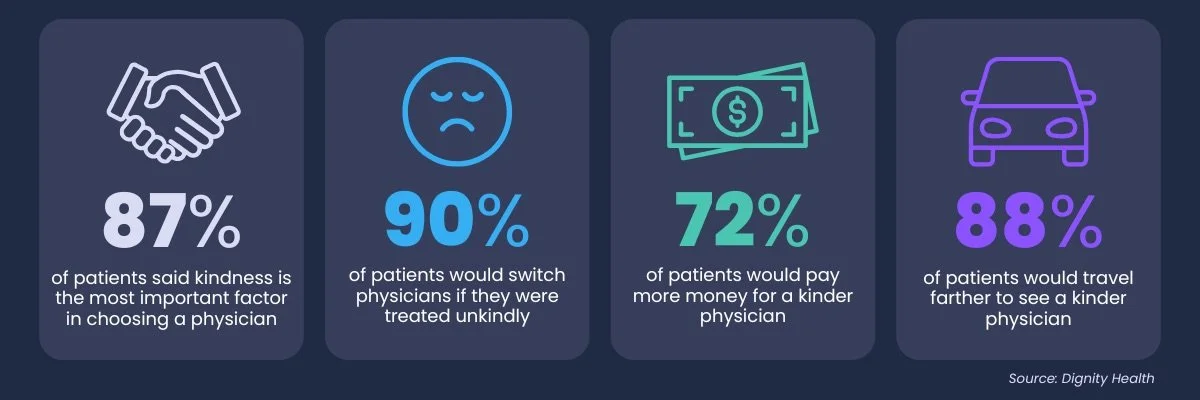
And what is true in healthcare settings applies to other areas of work.
A recent study by Forbes showed that kindness at work is a bigger predictor of satisfaction than income. Which means that those little gestures of care (remembering your coworker's coffee order or their child's birthday) have an outsized impact.
But kindness and intentional acts of care are one of the first things that go out the proverbial window when life and work get stressful: our vision narrows and it feels like all we can do is hang on - who can spare a thought for someone else?
What is kindness?
I'm leading a new training next week on why kindness at work is a competitive advantage and, over the next few newsletters, I'll be unpacking the three, component parts of kindness (and give you some actionable tips on how to bring more kindness to your workplace!)
Truth
Dignity
Boundaries
We'll also look at why kindness so often gets confused with being "nice" (and the damage that can happen, as a result).
I'll wrap up today's intro on kindness with a good, working definition:
Kindness is the active practice of treating people with dignity and generosity of spirit while telling the truth and honoring healthy boundaries
And a closing question - what aspect of kindness (kindness with truth, kindness with dignity, or kindness with boundaries) do you struggle with most?